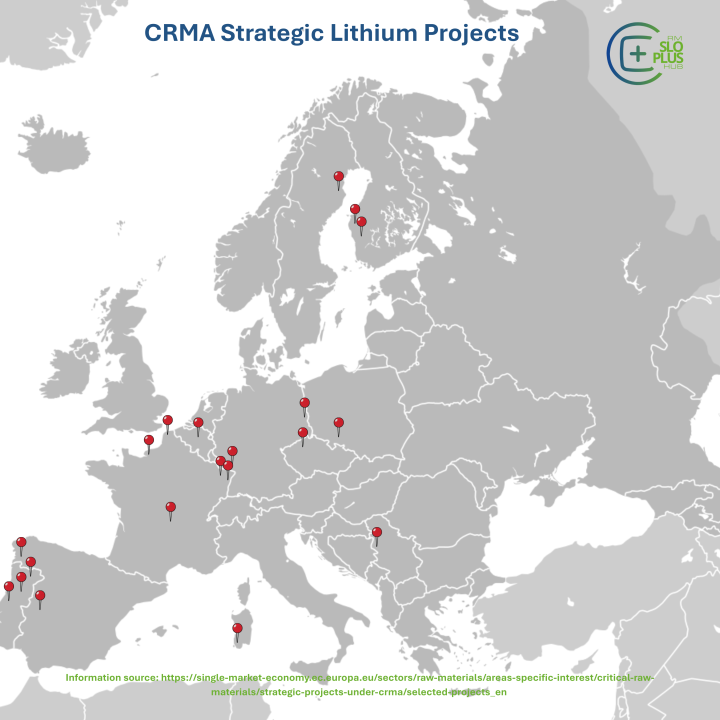
However, beyond regulatory frameworks and economic motivation, the success of such initiatives largely depends on obtaining a Social Licence to Operate (SLO) and earning public trust in the mining and/or processing industry. Since this has been one of the main objectives of our RM-SLO-PLUS-HUB project, we would like to highlight a few ongoing case studies from different parts of Europe, which also involve our project partners.
A notable example of successfully obtaining SLO can be observed in Finland, where Keliber, a mining and battery chemicals company, integrates lithium ore extraction with mineral processing and incorporation into final products such as electric vehicle batteries. The mine began operations in February 2026 at the Kaustinen site and is connected to the Kokkola site, which is expected to become operational in the autumn 2026 with an overall number of employees being 350. The deposits, totaling 12.7 million tons of lithium ore, represent one of the most significant resources in Europe, alongside major sites in Serbia, Germany, and the Czech Republic. Kaustinen and Kokkola sites are expected to support the annual production of 15,000 tons of lithium hydroxide for the battery industry.
In addition to supporting projects within EU Member States, the European Union has also identified 13 strategic projects in non-EU countries, one of which is the Jadar project in Serbia. The Jadar deposit located in Eastern Serbia contains high-quality boron and lithium, and has the potential to support long-term production and supply lithium for decades. However, while Finland has successfully aligned regulatory oversight and community engagement, the situation in Serbia shows that the absence of public trust and perceived environmental risks can significantly hinder success of such projects. Namely, there is concern and fear among the locals of the Jadar Valley region that the opening of the mine might cause an ecological disaster. This concern comes from the consequences that the previous operations of the main mining company – Rio Tinto – have left on nature in other parts of the world, but also from the lack of trust to the national decision makers.
A similar pattern of early resistance can be observed in Majevica in Bosnia and Herzegovina, where lithium exploration activities have triggered public concern. Although extensive geological investigations have already been completed, estimating resources of approximately 2 million tons of lithium carbonate. Despite this potential for local development, communities have expressed skepticism, largely driven by fears of environmental degradation and lack of trust in institutional processes, further provoked by intransparency of the concession approval process. Additionally, regional dynamics, including the experience of the Jadar project, have influenced public perception and contributed to prejudices toward mining initiatives, even though Bosnia and Herzegovina itself has a strong mining tradition dating back at least 800 years.
A comparative analysis of these cases reveals that the key determinants of SLO extend beyond geological potential and economic viability. Factors such as institutional trust, transparency, early and continuous stakeholder engagement, and effective communication play a decisive role in shaping public acceptance.
European ambition to secure critical raw materials for the green transition cannot be achieved solely through policy frameworks and resource availability. The Social Licence to Operate emerges as a crucial, and often decisive, factor in determining whether mining projects can proceed.