Cement and concrete production is one of the most carbon-intensive industries, with large quantities of CO₂ being released due to both production processes in the kiln and fuel combustion. Presently, cement industry makes up to 8% of yearly global carbon emissions. Heidelberg Materials, a 150 years old company is one of the world’s largest manufacturers of building materials, with around 51,000 employees in more than 50 countries across the globe.
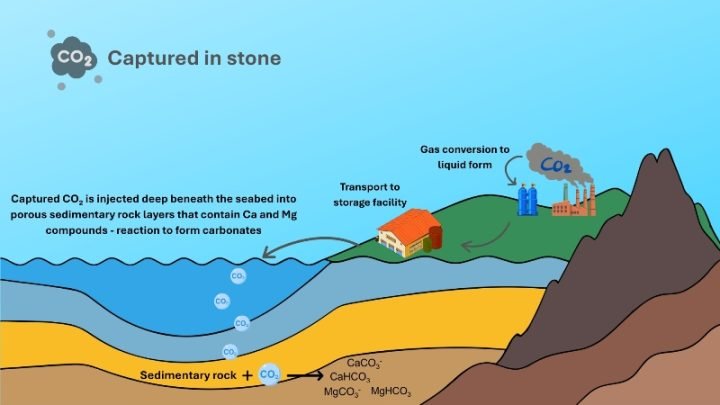
This company aims to reduce its specific net CO₂ emissions to 400 kilograms per ton of cementitious material by 2030 (almost half, comparing to 1990) and to achieve net-zero emissions across its entire value chain by 2050. To achieve the set limits, Heidelberg Materials has developed and put emphasis on Carbon Capture, Utilization, and Storage (CCUS) technology that captures CO₂ from production before it reaches the atmosphere. Their Brevik plant in Norway is the first in the world full-scale CCUS facility in the cement industry, where approximately 400,000 tones of CO₂ will be captured annually (half of the plant’s total emission) before it reaches the atmosphere. The captured carbon dioxide will be converted into liquid form and transported to an offshore storage site that is part of the Northern Lights project, a large-scale CO₂ transport and storage initiative in Norway. Captured CO₂ will be injected deep beneath the seabed into porous sedimentary rock layers, preventing it from leaking back into the ocean.
Our project is following these technological achievements with great attention. If goals to decarbonize one of the most carbon-intensive sectors on the global scale, a cement industry, is fully successful, it will set an example for easier access to social licence to operate (SLO) for this type of industry in the future, at some new locations. Ultimately, this can lead to even more creation of the new workplaces for young people in the environmentally acceptable industry and better working conditions.

