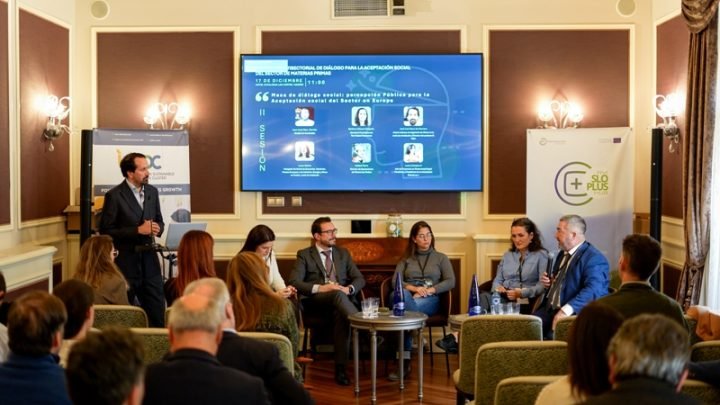
On 17 December in Madrid or partner the Iberian Sustainable Mining Cluster (ISMC), organized a stakeholder workshop brought together representatives from industry, public authorities, academia, civil society, and international organisations to explore the role of social acceptance in the delivery of raw materials projects. The event provided a structured platform to discuss how the Social Licence to Operate (SLO) can be effectively integrated into EU raw materials strategies.
Participants agreed that social acceptance is no longer a secondary concern or purely reputational issue. In today’s context of heightened societal scrutiny, environmental awareness, and governance expectations, SLO has become a necessary condition for project feasibility, alongside technical, legal, and financial requirements. They concluded that legitimacy is shaped locally, influenced by institutional credibility, historical context, and perceived fairness.
The first part of the workshop focused on connecting social acceptance to broader EU objectives, including supply security and international cooperation. While EU policies aim to accelerate strategic projects and strengthen partnerships, the discussions emphasised that successful implementation depends on alignment between policy ambition, governance capacity, and public trust. Without this alignment, permitting processes, investment decisions, and project timelines face increased risk.
The second part explored the territorial, social, and digital dimensions of legitimacy. Participants highlighted that technical feasibility and legal compliance alone are not enough because communities evaluate projects based on lived experience, historical memory, and fairness. SLO is strongest when embedded from the earliest stages in governance, stakeholder engagement, and communication. The workshop also underscored the growing role of digital platforms in shaping public perception, making clear and consistent communication more important than ever.
Overall, the workshop demonstrated that legitimacy is a strategic advantage. Organisations that integrate social acceptance into project planning, governance, and communication are better positioned to deliver resilient and sustainable raw materials projects. The RM-SLO-PLUS-HUB provides practical tools to support this approach, turning dialogue, trust, and engagement into concrete enablers of sustainability and supply security.