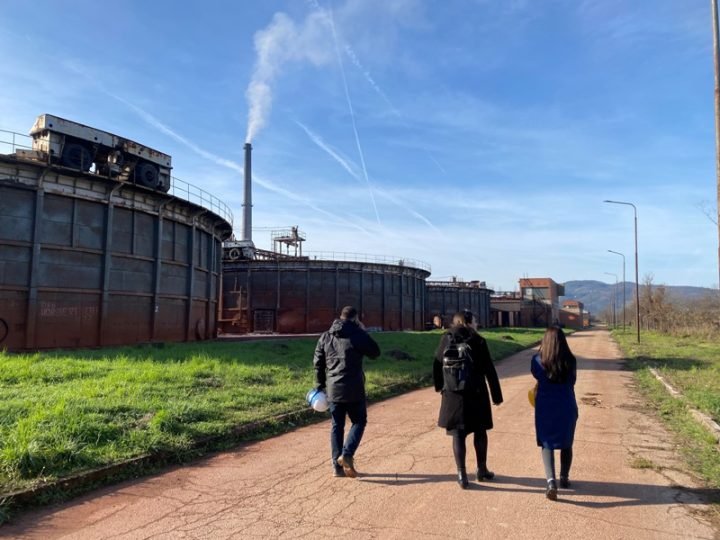
In the path toward sustainable development and the advancement of industrial processes, collaboration between academia and industry has become a key driver of innovation. In this context, at the end of last year, representatives of the University of Banja Luka (UNIBL) organized a visit to Nova Alumina Ltd. factory in Bosnia and Herzegovina in the frame of the RM-SLO-PLUS-HUB project.
Founded in 1978, Nova Alumina is one of the most important and largest industrial complexes in the Balkan region. While the factory initially focused on the production of alumina and pure aluminum, over the past decade it has expanded exponentially into the field of aluminosilicate chemistry, producing various types of aluminum hydrates, finely precipitated hydrates, more than ten types of zeolites, silica gel, and liquid water glass. Notably, Nova Alumina is the only modern factory in Europe producing soft aluminum, which positions it as a significant international manufacturer of aluminosilicate products on both the European and global markets.
In 2020, the University of Banja Luka established collaboration with Nova Alumina through the RIS RESTORE project, funded by the EIT RawMaterials initiative. The aim of the project was on valorization of solid waste generated during bauxite processing — red mud. This valorization is crucial because the factory has been continuously producing and storing large quantities of this material since its establishment. Within the project framework, Sunčica Sukur, a chemistry student at UNIBL, managed to successfully extract iron oxides from the red mud, resulting in a national patent.
Given that the red mud contains other valuable compounds, the collaboration between the University and the factory continues under the RM-SLO-PLUS-HUB project. Therefore, the recent factory visit was organized to hold a meeting with process engineers to discuss operational management and gather insights for ongoing research. During the visit, samples were also collected for further research on the material valorization, which will be carried out by UNIBL master’s student Nikolina Landeka, as part of her thesis. Such collaborations not only strengthen the bridge between academic knowledge and industrial practice but also pave the way for innovative solutions that transform industrial by-products into valuable resources.
By combining scientific expertise with practical industrial experience, projects like RM-SLO-PLUS-HUB demonstrate how sustainable development can be achieved through strategic partnerships, turning challenges into opportunities for innovation and growth.
This field trip also included the visit to “Solana”, a factory with over 40 years of history, which is correlated to the successful salt mine in the City of Tuzla. With history of mining of over 3000 years, and the halite (NaCl) deposits potentially over 50 M tones, Tuzla might play a major role in future European sodium ion battery chain. This was the subject of discussion with the leadership and research experts. The base for further collaboration is established and services of the RM SLO Hub were offered to support the R&D of this important industry.